
- Home
- Packages
- Tours
- Day Trips
- Trip Styles
Ready to Explore Morocco?
- About Us
- Blog
- Privacy Policy
- Contact Us


- Home
- Packages
- Tours
- Day Trips
- Trip Styles
Ready to Explore Morocco?
- About Us
- Blog
- Privacy Policy
- Contact Us
Morocco Desert Tours: The Ultimate Guide to Experiencing the Sahara
There’s a moment on every desert trip — the engine of the 4×4 cuts off, the road noise fades out, and you’re left with a silence most people have genuinely never experienced. The wind shifts the sand around a little, a camel grunts somewhere off in the distance, and the sky slides into a deep, bruised purple as the sun drops behind dunes that look, honestly, like waves frozen mid-motion.
If you’re heading to North Africa, the Sahara deserves a spot on the list. It’s not just scenery, it quietly resets how you think about scale and distance. Getting there does take planning, though: the desert is enormous, the drives are long, and the gap between an okay trip and one you’ll talk about for years comes down to logistics.
Wait — Is the Sahara Actually in Morocco?
It is, yes. The Sahara stretches across roughly 3.6 million square miles and touches 11 countries, and Morocco’s southeastern edge dips right into it, giving travelers some of the most spectacular and accessible dune fields on the continent, backed by a tourism scene that ranges from simple Berber bivouacs to genuinely luxurious camps with private showers.
Which Part of the Desert Should You Actually Visit?
Not every stretch of desert in Morocco is the same, and which one you pick shapes the whole trip.
Erg Chebbi
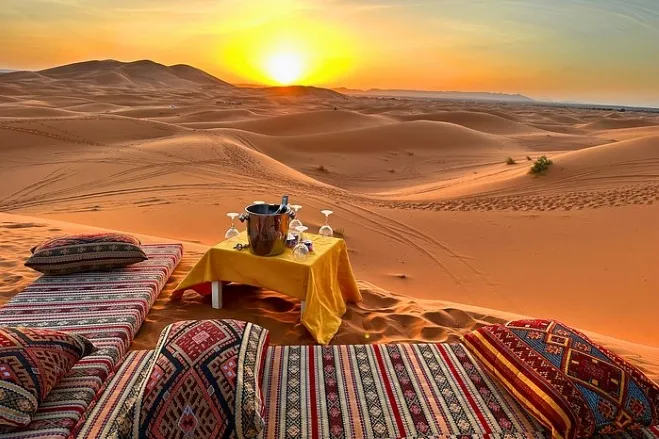
Erg Chebbi, near Merzouga, is the one you've probably seen in photos, orange dunes climbing up to 150 meters, with a paved road running right up to the sand. It suits first-timers, families, and anyone after that classic dune shot, and you'll want at least a 3-day desert trip from Marrakech or Fes to do it properly.
Erg Chigaga
Erg Chigaga, out past M'Hamid, is the wilder option, Morocco's biggest sand sea, and you only get there by a real off-road drive across rocky hammada. It's worth it if you're after total isolation and skies with zero light pollution, but budget at least four days from Marrakech to make it work.
Zagora
Then there's Zagora, closer to Marrakech but with only small, flattish dunes on rocky ground. Fine if you're stuck with two days, though with three or more we'd steer you toward Chebbi or Chigaga instead.
So What's a Desert Tour Actually Like?
Honestly, the drive is half the trip. A good private tour doesn’t just barrel through, it stops for palm groves, crumbling kasbahs, lunch in some small Berber village, and the scenery shifts from snow-capped peaks to rocky canyon to open sand, sometimes all in one afternoon.
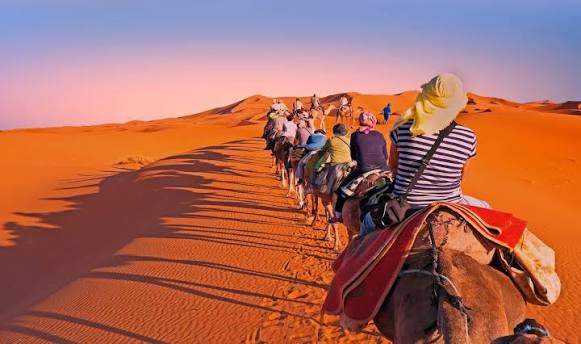
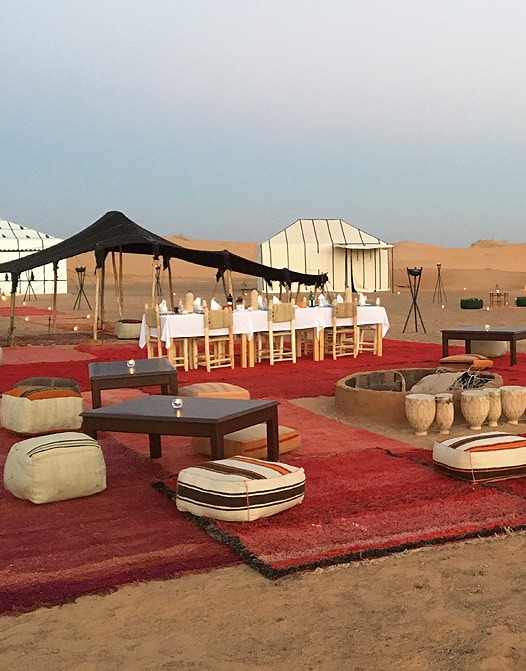
Late in the day, you’ll trade the vehicle for a camel and head into the dunes with a local Berber guide, timed so the sun drops just as you crest the last rise. Camp that night is either a traditional tent with shared facilities or a luxury setup with a real bed and your own bathroom. Dinner’s a tagine under the open sky, and the evening usually ends with a fire and Berber drumming. With no light pollution nearby, the stars are something else, and most camps wake you before dawn to climb a dune for sunrise.
Where Should Your Trip Start?
Desert tours from Marrakech are by far the most common route, up over the Tizi n’Tichka pass, past the Aït Ben Haddou kasbah, through the Dadès or Draa valleys, and out to the dunes, usually as a 3- or 4-day loop back into the city. Starting in Fes instead means driving south through the cedar forests of the Middle Atlas (watch for Barbary macaques along the way) before finishing in Marrakech. Coming in through Casablanca or Tangier? A desert leg slots easily into a longer trip that also takes in Chefchaouen and Fes. And if the long Atlas crossing isn’t for you, flying straight into Ouarzazate drops you right at the desert’s doorstep.
Picking the Right Style of Tour
A luxury desert tour means a nicer 4×4, boutique kasbah stops, and a camp with proper meals and extras like sandboarding. A private desert tour is the sweet spot for most people, just your group, a driver-guide, and no fixed pace, priced per vehicle. If you’re solo or on a budget, small group desert trips let you share a minibus and split the cost.
When Should You Go?
Spring, roughly March to May, is the safest window, warm days, cool nights, clear skies for stargazing, though it books out early, so don’t leave it too late. Autumn runs a close second, and October especially tends to be beautiful. Winter brings genuinely cold desert nights even though the days stay pleasant, so lean toward a luxury camp with proper blankets if you’re going then. Summer inland regularly climbs past 110°F, so if that’s your only window, stick to an air-conditioned camp and let your operator shift the schedule to dodge the worst of the heat.
When Should You Go?
Spring, roughly March to May, is the safest window, warm days, cool nights, clear skies for stargazing, though it books out early, so don’t leave it too late. Autumn runs a close second, and October especially tends to be beautiful. Winter brings genuinely cold desert nights even though the days stay pleasant, so lean toward a luxury camp with proper blankets if you’re going then. Summer inland regularly climbs past 110°F, so if that’s your only window, stick to an air-conditioned camp and let your operator shift the schedule to dodge the worst of the heat.
Why Does Booking Locally Matter?
Search around for Morocco desert tours and you’ll find plenty of overseas agencies acting as middlemen, taking a cut before your booking reaches an actual local driver. Seekers Travel Morocco is based in Ouarzazate, about as close to the desert’s front door as you can get, with offices in Marrakech and Casablanca too. We check the camps and vehicles ourselves rather than going off reviews, and if a road closes in the Atlas, you’re talking straight to people who’d know. Read more about our story here.
Ready to Plan Yours?
Take a look at desert tours from Marrakech, Fes, Casablanca, Tangier, and Ouarzazate, or browse all tour packages. The dunes aren't going anywhere — but get in touch and let's get you out there.